

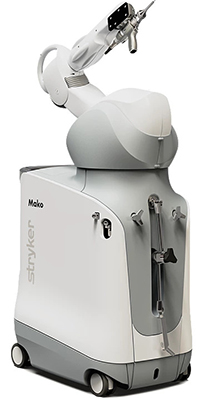
 Mako® Shoulder is a robotic-arm assisted option for primary reverse total shoulder replacement. It brings together Mako robotic technology, Blueprint® 3D preoperative planning, and Tornier® Perform™ reverse shoulder implants so your surgeon can plan your case in detail and prepare the glenoid (socket) with haptic guidance in the operating room.
Dr. Jason Shrouder-Henry is a board-certified, fellowship-trained orthopedic surgeon specializing in the hand, wrist, elbow, and shoulder. He cares for adults and children in Westmont, Western Springs, Munster, and the greater Chicago area. When reverse shoulder replacement is recommended, he can discuss whether Mako robotic-arm assistance is appropriate for you.
What Is Mako Shoulder?
Mako Shoulder is Stryker’s robotic-arm assisted platform specialized for reverse shoulder replacement. Unlike a conventional reverse replacement that relies only on standard instruments, Mako Shoulder adds preoperative 3D planning and intraoperative AccuStop™ haptic technology to help the surgeon execute glenoid preparation according to the plan.
What Does Mako Shoulder Include?
- Blueprint 3D preoperative planning, surgeon-controlled virtual planning before surgery
- Mako robotic arm with AccuStop haptic boundaries during glenoid preparation for primary reverse replacement
- Tornier Perform Reversed and Reversed Augmented glenoid implants selected for your anatomy
Who Is a Candidate for Mako Robotic-Assisted Reverse Shoulder Replacement?
You may be evaluated for reverse shoulder replacement, with or without Mako assistance, if nonsurgical care has not controlled your symptoms and imaging shows arthritis with a rotator cuff that cannot reliably power a conventional (anatomic) replacement.
Common Reasons Patients Are Evaluated
- Rotator cuff tear arthropathy (arthritis plus a large or irreparable rotator cuff tear)
- Severe shoulder pain that limits dressing, reaching, sleep, or overhead activity
- Weakness or loss of motion after failed conservative care (rest, medications, injections, physical therapy)
- Selected patients for whom primary reverse shoulder replacement is the recommended operation
Mako Shoulder is intended for primary reverse shoulder replacement. Revision cases, unusual bone loss, or other complex problems may need a different approach. Dr. Shrouder-Henry will review your history, examine your shoulder, and use X-rays or other imaging before recommending surgery.
How Does Blueprint 3D Planning Work Before Surgery?
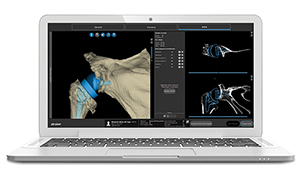
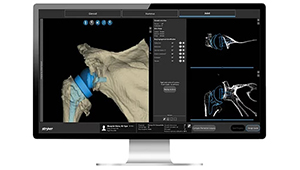
Blueprint is surgeon-controlled 3D preoperative planning software. It helps create a virtual view of your shoulder so the team can understand pathology, anticipate challenges in the operating room, and evaluate implant options before the day of surgery.
What Blueprint Planning Helps Your Surgeon Do
- Review glenoid version, inclination, and bone support in three dimensions
- Anticipate intraoperative challenges related to your anatomy
- Compare reverse implant configurations, including Tornier Perform options
- Build confidence in the plan before you enter the operating room
Planning supports decision-making. Final implant choice and surgical steps remain under your surgeon’s control.
How Does AccuStop Haptic Technology Help During Surgery?
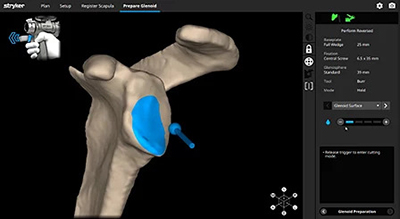
During glenoid preparation for primary reverse replacement, Mako Shoulder uses AccuStop haptic technology to create a virtual boundary. That boundary assists the surgeon while preparing the glenoid surface, boss, and post/screw pathway according to the preoperative plan.
Intraoperative Focus Areas
- Haptically guided reverse shoulder glenoid implant preparation
- Preparation of the glenoid surface, boss, and post/screw as planned
- Surgeon remains in control of the robotic-arm assisted steps
What Implants Are Used With Mako Shoulder?
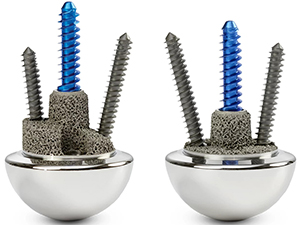
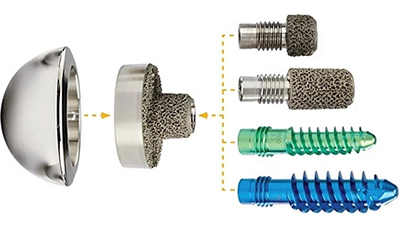
Mako Shoulder is integrated with Tornier Perform Reversed Glenoid and Reversed Augmented Glenoid implants. These implants are designed for reverse shoulder arthroplasty, including cases related to cuff tear arthropathy and osteoarthritis, and to address a range of glenoid bone-loss patterns.
Why Implant Choice Matters
In reverse shoulder replacement, the ball and socket positions of the artificial joint are reversed so the deltoid muscle can help move the arm when the rotator cuff is severely damaged. Matching implant design to your glenoid anatomy is an important part of planning and may include augmented options when bone loss is present.
Does Robotic-Arm Assistance Improve Accuracy?
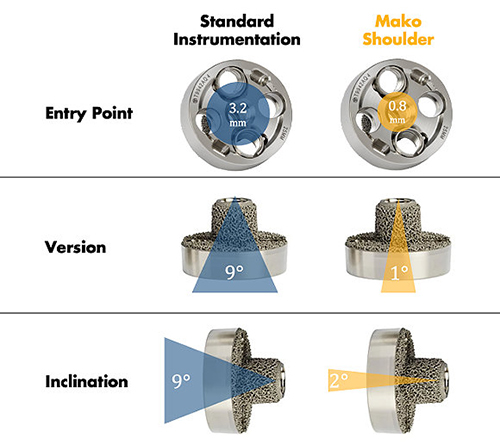
A bench-top study comparing Mako Shoulder robotic-arm assisted glenoid preparation with manual preparation using standard instrumentation reported more accurate implant positioning relative to the preoperative plan. Individual results vary. Robotic assistance is a tool to help execute the plan; it does not eliminate surgical risk and does not guarantee a specific outcome for every patient.
What Happens During Mako Robotic-Assisted Reverse Shoulder Replacement?
Surgery is performed under anesthesia in a hospital or surgery center. While details depend on your anatomy and implant, the general sequence is:
Step-by-Step Overview
- Your Blueprint plan guides implant selection and glenoid preparation targets
- An incision exposes the shoulder joint
- Damaged joint surfaces are prepared; on the glenoid side, the Mako robotic arm and AccuStop haptics assist preparation to plan
- Tornier Perform reverse components are implanted with reversed ball-and-socket geometry
- Soft tissues are repaired and the incision is closed
What Is Recovery Like After Surgery?
Recovery after robotic-assisted reverse shoulder replacement is similar to other reverse shoulder replacements and is personalized to you.
Typical Early Recovery Focus
- Sling use as instructed to protect the repair and implant
- Pain control, wound care, and activity limits reviewed before discharge
- Physical therapy to restore motion and strength over time
- Avoiding overhead lifting and pushing up from a chair with the operated arm until cleared
Ask Dr. Shrouder-Henry about expected length of stay, therapy timeline, and return to driving, work, and hobbies.
What Are the Risks of Reverse Shoulder Replacement?
All shoulder replacement surgery carries risks. These may include infection, dislocation or instability, fracture, nerve or blood-vessel injury, blood clots, wound problems, stiffness, ongoing pain, and wear or loosening of implants over time. Robotic-arm assistance does not remove these risks. Discuss benefits and alternatives with your surgeon before deciding.
Mako Shoulder vs Conventional Reverse Shoulder Replacement
Both procedures replace the damaged joint with reverse geometry implants. The main differences with Mako Shoulder are Blueprint 3D planning before surgery and robotic-arm assisted, haptically guided glenoid preparation during primary reverse replacement. Conventional reverse replacement uses standard instruments without that robotic workflow. Your surgeon will explain which approach fits your diagnosis.
Frequently Asked Questions About Mako Shoulder
Is Mako Shoulder the Same as Mako for Hip or Knee?
Mako is Stryker’s robotic-arm assisted family of technologies. Mako Shoulder is the application specialized for reverse shoulder replacement, integrating Blueprint planning and Tornier reverse implants. Hip and knee Mako workflows are separate systems and indications.
Will I Definitely Have Less Pain With Mako?
No technology can promise a pain-free result. Mako Shoulder is designed to support accurate execution of a personalized glenoid plan. Your pain relief depends on your diagnosis, implant, rehabilitation, and overall health.
How Do I Know If I Need Reverse Replacement Instead of Anatomic Replacement?
Anatomic total shoulder replacement usually needs a functioning rotator cuff. When the cuff is irreparable or cuff tear arthropathy is present, reverse replacement is often preferred because it relies more on the deltoid. Imaging and a clinical exam guide that decision.
Where Can I See Dr. Shrouder-Henry?
Dr. Shrouder-Henry sees patients in the Westmont, Western Springs, and Munster areas and serves the greater Chicago region. Request an appointment online or call the office to discuss shoulder arthritis, rotator cuff problems, or reverse shoulder replacement options including Mako.
Schedule an Appointment
If shoulder pain from arthritis or rotator cuff failure is limiting your daily life, Dr. Shrouder-Henry can help you understand whether reverse shoulder replacement and Mako robotic-arm assistance may be right for you.